冰与火之歌
Maanaadu Turns Four As Venkat Prabhu and Fans Celebrate a Genre Shifting Blockbuster_我的网站

一 |
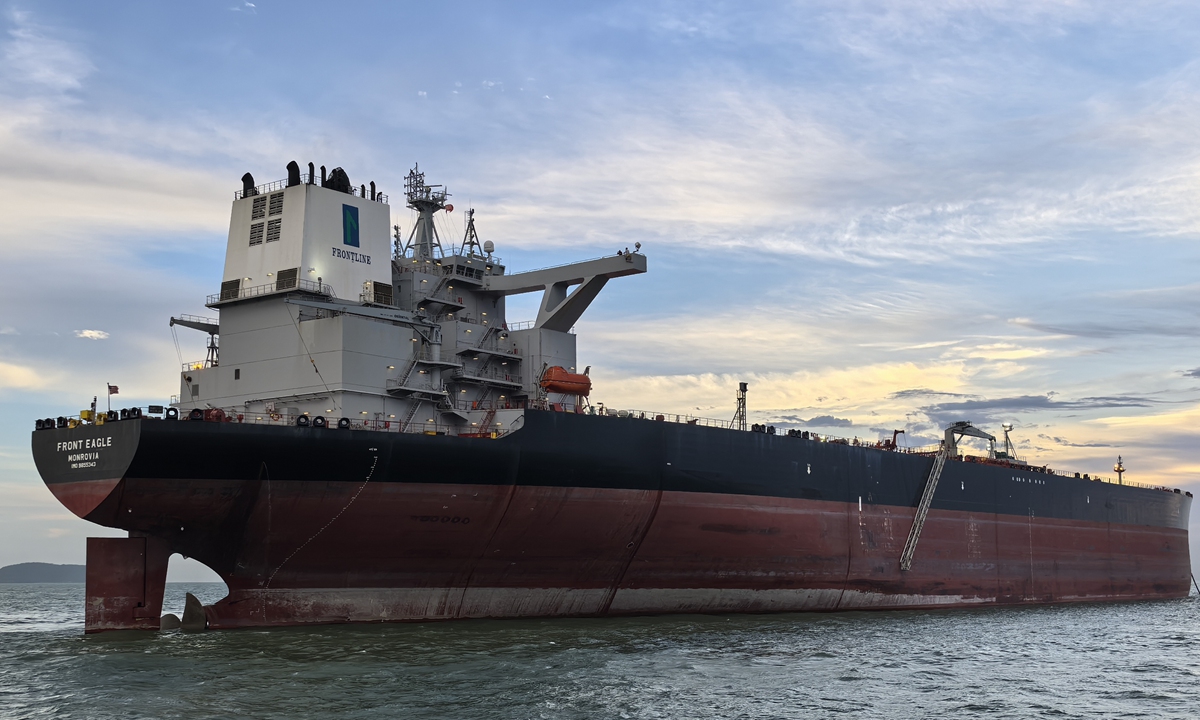
In 2025, two crude oil tankers collided at the eastern entrance to the Strait of Hormuz, 24 nautical miles off Fujairah, United Arab Emirates, media reported.
Owned by oil tanker operator Frontline, the Liberia-flagged vessel Front Eagle collided with the Antigua and Barbuda-flagged vessel Adalynn on the morning of June 17, 2025.
The Adalynn was damaged in the fire. While the Front Eagle was undergoing repairs in Shenzhen, South China's Guangdong Province, Global Shipping Holding Ltd., which owns the Adalynn, applied to Guangzhou Maritime Court for its arrest. Frontline provided a cash security of 203 million yuan to release the arrest and applied to establish a limitation fund for maritime claims.
The court approved the application and allowed Frontline to establish the limitation fund, setting the amount of the fund at 168 million yuan.
Guangzhou Maritime Court held four pretrial conferences on October 11, 2025, January 12, May 6 and July 13, 2026 to complete preparations for evidence examination, technical investigations and reported the relevant pretrial arrangements to the provincial high court, the Global Times learned from the court.
The court held a public hearing for the case on July 14, 2026.
No government agency had conducted an investigation into the collision, and no official findings were issued after the accident. Taking into account the unique burden-of-proof challenges in maritime collision disputes, Guangzhou Maritime Court took measures to preserve key evidence when handling the vessel arrest, including navigation logs, AIS data, voyage data recorder (VDR) records and CCTV footage, the court told the Global Times in a statement on Sunday.
Under a process that involves exchanging evidence inventories, sealing materials simultaneously and jointly reviewing them after evidence submissions, the court helped ensure the authenticity of critical records and laid the groundwork for determining the facts of the case.
As the two sides and their respective maritime experts reached sharply different conclusions over liability, the court introduced a maritime technical investigator mechanism, with the consent of both parties, allowing technical experts to participate throughout the proceedings. Drawing on the preserved evidence, investigators reconstructed the collision, assessed the vessels' encounter situation and clarified the parties' respective responsibilities.
Following the hearing, the court facilitated mediation, and the two parties reached a settlement agreement on July 27, 2026. On July 31, the court organized the distribution of the maritime liability limitation fund among creditors involved in the foreign vessel collision dispute and related charter-party disputes.
Representatives of the Adalynn traveled from overseas to the court to present a letter of appreciation and a commemorative banner in recognition of the court's efforts, according to the court statement.
After the Guangzhou Maritime Court accepted the case, both parties agreed to apply Chinese law to establish a maritime liability limitation fund and resolve their substantive dispute, breaking away from the long-standing reliance of international shipping disputes on European and US courts and legal systems.
Choice of justice
Bilov Viacheslav, a representative of Global Shipping Holding Ltd., told the Global Times that the main reason they chose a Chinese court to mediate the case is that "we want absolutely fair, unbiased approach to this issue. Because nowadays in this world, there are some countries which believe that they are authorized to give instruction to all others, which definitely is having influence on the decisions of the judge on the approach to the case."
Viacheslav gave the Chinese court's handling of the case a five-star rating, saying he had expected the dispute to take at least three years to resolve, but the Chinese court settled it within just one year. He also praised the judges and lawyers for their commitment to advancing the case throughout the proceedings.
"The judges and lawyers worked to advance the case with the same level of commitment as I did, even though the case directly concerned my own interests. This left a deep impression on me about litigation in China," Viacheslav said.
The case involved two foreign parties and a collision that occurred near the Strait of Hormuz, with no direct connection to China or Guangzhou Maritime Court initially. The fact that the parties chose to seek vessel arrest in China and agreed to apply Chinese law demonstrates the credibility and appeal of China's maritime judicial system, Wu Guining, vice president of the Guangzhou Maritime Court, who served as the presiding judge of the case, told the Global Times.
The court also introduced a maritime technical investigator mechanism in the case, an innovation aimed at addressing complex technical issues arising from vessel collision accidents, Wu said, noting that through technical investigations, the court was able to establish the facts of the case more efficiently, highlighting the integration of professional maritime investigation capabilities with China's specialized maritime adjudication system.
The case demonstrates China's ability to handle major, complex and cross-border maritime disputes with professional expertise, Wu said.
The handling of the collision between the two vessels is just one example of how Chinese courts have been dealing with a growing number of foreign-related maritime cases in recent years.
The Global Times learned from China's Supreme People's Court (SPC) in October last year that over the past 40 years, Chinese courts have handled a total of 88,000 foreign-related maritime cases involving parties from 146 countries and regions.
At a lecture held by the SPC on Friday, Shen Hongyu, director of the Fourth Civil Division of the SPC, told the Global Times that in recent years, Chinese courts have become more influential in participating in and promoting global ocean governance reform. Maritime justice serves as an important instrument for practicing the vision of a maritime community with a shared future and for advancing the reform of the global ocean governance system.
。 Venkat Prabhu’s Maanaadu completed four years on Tuesday, rekindling conversation around a film that changed the way mainstream Tamil cinema approached high concept storytelling. Released on 25 November 2021, the Silambarasan and SJ Suryah starrer arrived amid strong expectations and went on to surpass them with ease. Critics praised its audacity, its urgency and its playful rhythm, while audiences embraced it with enthusiasm that lasted far beyond its theatrical run.A milestone for one of Tamil cinema’s boldest commercial experimentsTo mark the occasion, Venkat Prabhu shared a heartfelt note on X, thanking viewers for supporting his most daring narrative experiment. He wrote that when the team set out to make a crazy time loop film, he believed one thing with absolute certainty. The audience would understand it. What surprised him, he wrote, is that the audience understood it even more deeply than the team had imagined. His message also expressed gratitude to Silambarasan and SJ Suryah for trusting the attempt and for pushing cinematic boundaries along with him.The filmmaker’s sentiment captures precisely what has given Maanaadu its lasting value. At a time when Tamil commercial cinema was largely anchored in familiar narrative patterns, Maanaadu disrupted the space with a story built on repetition, acceleration and cause and effect logic, while still delivering the emotional punch and entertainment value that fans look for in a star vehicle. When we made this crazy time-loop film #Maanaadu, I believed one thing for sure that our audience will get it…And you all got it MORE than we imagined!Thank you for celebrating experiments in cinema. You make us push boundaries.. thanks for the belief @SilambarasanTR_… pic.twitter.com/1ovVaCvnpY — venkat prabhu (@vp_offl) November 25, 2025 The time loop thriller that redefined Simbu’s careerMaanaadu follows Abdul Khaaliq, played by Silambarasan, an NRI who lands in Tamil Nadu for a wedding, only to become trapped in a relentless time loop that keeps dragging him back to the same morning. What begins as confusion gradually becomes a nightmare as he discovers that a political conference, a high-profile assassination and the machinations of a ruthless police officer, played with wicked brilliance by SJ Suryah, are all tied to his fate.The film is built on a loop structure where each repetition increases the pressure. It demands that the audience think along with the protagonist, piece together clues and learn the rules of the world as he does. What makes the experience exhilarating is the duel between Silambarasan and SJ Suryah, two performers operating at full throttle. Every loop becomes a new contest, a new performance within the performance, and a new chance to push the tension higher.Upon release in 2021, the film was declared one of the best Tamil films of the year by several publications. It became one of the biggest commercial successes of Silambarasan’s career, reaffirming his image as a star willing to take risks and reinvent himself. For a generation of fans, Maanaadu is remembered not only as an entertainer but also as a turning point for Simbu, one that ushered in a new phase of focus and discipline in his craft.The supporting cast strengthened the film’s impact. Kalyani Priyadarshan delivered an understated but warm presence. Manoj Bharathiraja, SA Chandrasekhar, YG Mahendran, Karunakaran, Premgi Amaren, Aravind Akash and Anjena Kirti rounded out a large ensemble that added texture to the loop many times over.Craft and commerce meet on a grand scaleMaanaadu’s triumph is also a technical success story. KL Praveen’s editing shaped the looping structure with clarity and rhythm, ensuring that the repetitions never felt monotonous. Richard M Nathan’s cinematography maintained fluidity across cycles, giving each loop a sense of urgency. Yuvan Shankar Raja’s score amplified the momentum, turning the film into a tightly wound thriller that never lost its emotional core. Produced by Suresh Kamatchi under V House Productions, Maanaadu reportedly grossed more than Rs 117 crore worldwide, emerging as a major commercial blockbuster that rewrote the expectations for a concept driven Tamil film.Four years later, the film remains a beloved reference point whenever Tamil cinema discusses innovation within a commercial format. Maanaadu not only succeeded but also proved that audiences welcome complexity and originality when crafted with conviction.Also Read: Thalapathy Vijay to collaborate with Venkat Prabhu for his 68th film。
Current article:http://br2g.zhouangnaoguangsundianzhenmou.cfd/8pd7h/p3hr.html
Published on:17:52:57
 黑金
黑金 四大名捕
四大名捕 出租车司机
出租车司机 知乎
知乎 焦糖
焦糖 史密斯夫妇
史密斯夫妇 新闻编辑室
新闻编辑室 极速前进
极速前进