
落日余晖
A closer look at Japan’s newly launched ‘spy bureau,’ a signal of its growing militarist ambitions_我的网站

A |
As an old saying in both Chinese and Japanese goes, "Bad deeds travel a thousand miles." This means that wrongdoing will eventually spread far and wide, becoming known to all.
Ignoring strong opposition at home and abroad, the Japanese government has officially inaugurated the "National Intelligence Bureau." Dubbed by some Japanese media outlets and opinion leaders as a postwar institution close to the "Tokko", or Special Higher Police - which targeted critics of the Japanese government ahead of World War II (WWII) - the new bureau has been met with widespread criticism and protests ever since its establishment on July 31.
What exactly is Japan's "National Intelligence Bureau"? What is the background of its organizational structure and leadership? What impact could its deep entanglement with US intelligence agencies have on regional security? And what strategic ambitions of the Japanese authorities lie behind its creation? In this story, the Global Times takes a closer look at this newly established intelligence agency and examines the dangerous attempts by Japan's right-wing forces to break free from the postwar order and revive a militarist path.
Striking a historical nerve
On July 31, Japan held the first meeting of its new National Intelligence Council chaired by Prime Minister Sanae Takaichi, and launched its secretariat, the National Intelligence Bureau, reported The Mainichi on the same day.
Although the full details have not been made public, the meeting was believed to have confirmed plans to draw up the first-ever strategy to guide intelligence-gathering and analysis activities, as well as to move forward with consideration of a "anti-espionage" bill aimed at countering covert operations by foreign powers, NHK reported the same day.
The bureau's launch date has struck a historical nerve in some Asian countries, victims of Japanese aggression during WWII.
Hiroshi Onishi, vice president of the Japan-China Friendship Association, told the Global Times that Japan's decision to establish the body on July 31 is a date that evokes memories of the notorious Unit 731 bacterial warfare squad of imperialist Japan, and is bound to remind people in China and other Asian countries of that dark history.
The Japanese government should consider how this timing may be perceived by people in other countries, especially in China, he said.
Under a law to establish the National Intelligence Council, passed by the Japanese Diet in May 2026, Japan is building a new intelligence system centered on its National Intelligence Bureau.
According to a July 31 story by the Xinhua News Agency, the bureau, which integrates intelligence functions from Japan's Ministry of Foreign Affairs, the Ministry of Defense, the Ministry of Justice and the National Police Agency, had been described by the public as the "command center" of intelligence operations.
Why did Japan establish this bureau? Establishing this bureau enables the Japanese government to "make sound decisions based on higher-quality, timely information amid today's complex and challenging international environment," The Japan Times quoted Chief Cabinet Secretary Minoru Kihara as saying on July 31.
However, to some Chinese scholars in Japanese studies, explanations like this are little more than a cover for the current right-wing Takaichi administration's real agenda.
"Of course, the Japanese authorities need to put forward some seemingly plausible justification; otherwise, they would have no way to explain it to the public," Da Zhigang, a research fellow at the Institute of Northeast Asian Studies of the Heilongjiang Academy of Social Sciences, told the Global Times.
Da said that the Takaichi administration's push for the reform of the intelligence system is directly tied to Japan's military expansion, its drive to strengthen military capabilities and constitutional revision.
"The real purpose is still institutional expansion - to make the intelligence system more compatible with, and better serve, the series of military expansion and geopolitical strategies Japan is now advancing," he noted.
Adding uncertainty
The National Intelligence Bureau largely inherits the roughly 730 personnel and functions of its predecessor, the Cabinet Intelligence and Research Office, with around 30 new posts being authorized to be added, according to The Japan Times.
The bureau reports directly to the Japanese prime minister, and has centralized intelligence functions that were previously dispersed across multiple ministries and agencies under Japan's cabinet office, which overturns Japan's postwar decentralized intelligence architecture, Da said.
"Compared with the system of mutual checks and constraints designed under Japan's pacifist constitution after the WWII, the country's current intelligence apparatus is highly centralized," Da told the Global Times. "Constraints that were once built into the Japanese constitution, which has set forth pacifism, now seem to be gone."
If the bureau is a new engine of centralization in Japan's intelligence system, then Kazuya Hara can be called the engine's first operator. According to media reports, Hara, the bureau's first director, joined Japan's National Police Agency in 1990, and had also served at Japan's embassies in Russia and the US. In 2019, Hara became executive secretary to the then prime minister Shinzo Abe, and in 2023 he began serving as director of Japan's cabinet intelligence.
In May, shortly after the legislation was passed, Hara reportedly made a special trip to the US Federal Bureau of Investigation (FBI) headquarters. FBI Director Kash Patel said in a post on X that Japan's initiative would "greatly enhance our shared partnership," and said he looks "forward to fully supporting them and working with them on cybersecurity, counterintelligence, espionage and counterterrorism to strengthen our cooperation," Japan's Jiji Press reported on May 8.
Moreover, according to a July 13 report by The New York Times, during the process of setting up the bureau, Japan had "privately approached partners such as the United States, Australia and Germany in recent months for advice on technology, staffing and priorities."
"Intelligence officials from the United States, Japan's main security ally, have offered input on cyberdefense systems and methods of countering industrial espionage, according to two people familiar with the conversations," the NYT report said.
A tightly bound intelligence alliance is adding multiple layers of uncertainty to the security landscape in Northeast Asia. Da said that the bureau's establishment would amplify Japan's intelligence-driven disruptive power in bilateral and multilateral geopolitical interactions in Northeast Asia, while its deep entanglement with intelligence networks beyond the region could further intensify the compound shock to the regional security order.
"For countries around Northeast Asia, the costs of social contact and other forms of interaction will rise," Da said.
The establishment and operational launch of a brand-new intelligence agency means that Japan is already making advance intelligence preparations for a potential war, Lü Yaodong, a research fellow from the Institute of Japanese Studies at the Chinese Academy of Social Sciences, told the Global Times.
East Asian countries, as well as all peace-loving forces around the world committed to safeguarding global peace, must remain highly vigilant, Lü said.
Accelerating Japan's remilitarization agenda
China has a time-honored saying: "Those who persist in wrongdoing will bring destruction upon themselves."
Less than two weeks after its launch, Japan's National Intelligence Bureau has already come under broad criticism. What it has triggered is not only questions about the functions of a new agency, but also deep concern over whether Japan is drifting away from its postwar path of peace and back toward militarism.
One major criticism is that the intelligence power in Japan has become overly concentrated, while checks and balances remain inadequate. The law to create the National Intelligence Council, which governs the bureau, "does not include any mechanism to oversee the activities of intelligence agencies" despite concerns, as reported in a May 29 editorial piece by The Mainichi.
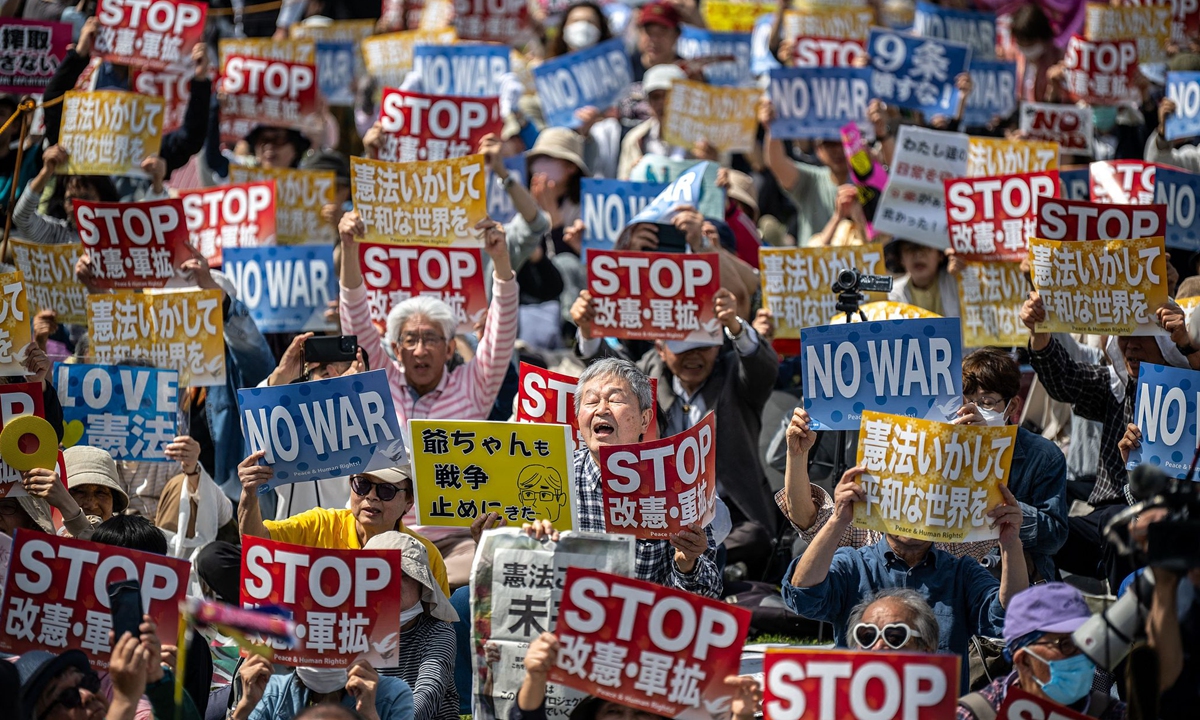
For many people in Japan, another concern is that the new intelligence agency lacks institutional safeguards to protect citizens' rights. On May 27, the day Japan's Upper House passed the law, large numbers of people reportedly spontaneously gathered outside Japan's Diet, holding banners reading "Stop revising the constitution and expanding the military" and "Oppose the National Intelligence Bureau bill that will monitor citizens."
It is completely unfeasible for Japan to set up an intelligence agency detached from corresponding restraints, said Makoto Ito, a Japanese lawyer and the director of the Japan Institute of Constitutional Law.
If the bureau and related measures such as the proposed anti-espionage law are allowed to push forward on their own, outside a democratic oversight framework, the risks will only be magnified, Ito told the Global Times.
More concerning still, some observers pointed out that the establishment of the National Intelligence Bureau is not an isolated move, but a key link in the Takaichi administration's systematic effort to break free from the postwar order and push Japan further down a path of rearmament.
Japan is strengthening intelligence centralization through the creation of the bureau, while also accelerating the deployment of Tomahawk cruise missiles and conducting live-fire drills, said Lü. This indicates that Japan is advancing its military expansion strategy on two fronts at once: intelligence gathering and actual combat strike capability. He criticized these moves as not only a serious shock to the regional security landscape, but also an open challenge to the international order of peace.
The Takaichi administration is devoting energy to intelligence-system reform precisely when the public urgently needs relief from persistent inflation and a rising cost of living, and that these reforms directly serve Japan's military expansion, force buildup, constitutional revision and even efforts to undermine the country's Three Non-Nuclear Principles, said Da.
"In fact, this also shows that Japan's right wing has now reached a stage where it simply no longer cares about people's livelihoods," he said.
The establishment of Japan's National Intelligence Bureau is "another negative development in Japan's domestic and international policies on security," Chinese Foreign Ministry spokesperson Mao Ning said on July 31, the bureau's launch date.
"For some time, Japan has been accelerating its remilitarization agenda under the pretext of national security and external threat. Such moves have put the regional peace and stability at risk and drawn widespread concern across the international community," Mao warned.
"Those running the Japanese government need to learn lessons from history and act prudently," she noted.
。
巴黎奥运会开幕在即,东道主法国正在紧锣密鼓地做着准备工作。
上个月,马克龙接受采访时表示,法国致力于在巴黎奥运会期间推动“奥林匹克休战”,希望交战中的国家暂时放下争端,并希望在这方面得到中国的帮助。
因为中国在作为东道主国家申办北京冬奥会时,也做了同样的事情。
在最近,中方也表示,作为联合国安理会常任理事国和负责任大国,中国愿同法方一道,以巴黎奥运会为契机,倡议运动会期间全球停火止战。
俄罗斯、乌克兰之间以及巴勒斯坦、以色列之间的战争,一直是全球关注的重点。
此外,苏丹武装冲突仍在延续,自2023年4月15日起,战火从首都蔓延到全国,至今没有停火迹象。
全球人民都盼望着,奥运会这个和平的象征能让苏丹冲突双方暂时放下武器,让苏丹人民在来之不易的和平之中,获得喘息的机会。

B |
苏丹位于非洲东北部,曾是非洲国土面积最大的国家,还是联合国公布的世界最不发达国家之一。
自1956年独立以来,在这片土地上,政变和内战时有发生,始终没有办法彻底摆脱混乱。
2019年4月,巴希尔政权下台之后,苏丹各派系之间总是产生摩擦和冲突,始终没有建立一个有效的政府。
准军事组织“快速支援部队”和苏丹武装部队,在首都喀土穆悍然开战。
图源:新华社
冲突双方的领导人曾经结盟推翻前政府,因为利益分配问题,对昔日的盟友举起了武器。
居民们能听到战斗机在窗外频繁飞过,双方部队向彼此射击,居民推开窗户,看到的不是蓝天白云,而是交战引起的火光与浓烟。
流弹击穿窗户,掉落在居民的家中,提醒人们与危险只有一墙之隔。
图源:南方周末
在后续冲突中,一天之内落在恩图曼市一居民家门口的子弹
首都喀土穆的主要街道空无一人,所有桥梁都被封锁,民众撤离到地下室中,面临的是停水停电和食物短缺。
沙特阿拉伯航空公司一架客机在喀土穆发生的交火中受损,当时机上有多名乘客和机组人员。
去年9月17日,在冲突双方的新一轮交战之后,18层楼高的大尼罗石油作业公司大楼被大火笼罩,升起浓重的黑烟。
苏丹司法部大楼在炮火中被完全烤焦,玻璃被全部炸碎。
爆发冲突一年后,战火逐渐从初期的首都圈,向中部和西部蔓延,波及苏丹18个州中的11个。
自去年4月15日爆发武装冲突以来,在苏丹有至少14790人死亡,约33000人受伤,超过800万人流离失所。
整个国家都在战火下哀嚎,民众一心盼望着和平的到来。
比起那些受伤的人、受损的建筑,武装冲突在这个国家身上留下的隐形伤口,同样令人触目惊心。
战乱之下,昔日的秩序一夜崩塌,企业倒闭、工厂关门、贸易中断,民众只能看着自己和国家,滑向更深的深渊。
据经济专家估计,苏丹70%的经济活动都因为战乱停滞,直接和间接经济损失超千亿美元。
冲突爆发前,500苏丹镑能兑换50元人民币,爆发冲突一年之后,500苏丹镑只能换到6元人民币。
一位中国商人说:“有次睡一觉钱贬值20%,再也不敢将苏丹镑揣在兜里。”
图源:新华社
石油工业是苏丹的支柱产业,但随着动乱的发生,苏丹的石油产业缩减一半以上。
苏丹还是传统农业大国,农业产值占国内生产总值的三分之一,农业人口占65%。

C |
但因为战争,大量农业基础设施被破坏,人民流离失所,无心务农,耕地面积大大减少。

D |
农业这根支柱的崩塌, 不止对经济造成重创,还威胁到无数人的生存。
2023年苏丹谷物产量比上一年减少了46%,许多地区粮价比冲突之前上涨了2-3倍,全国仅有不到5%的人口每天可以吃到一顿饱饭。
最近,联合国世界粮食计划署警告称,“世界最大的难民危机”正在苏丹发生,并有可能进入全球规模最大的饥饿危机,距离饥荒只有一步之遥。

E |
为了躲避战乱,大量苏丹人民不得不背井离乡,离开扎根的土地。
当地时间4月24日,国际移民组织发布的最新报告显示,苏丹武装冲突已造成超过878万人流离失所,国际移民组织称,这是当前全球规模最大的流离失所危机。
有“象鼻之城”美誉的喀土穆,是战火肆虐最严重的地方,有超过半数人口远走他乡,到处都是空空荡荡的居所。
仓促的迁徙过程充满了危险,枪炮、饥饿、疾病潜伏在恶劣的环境之中,许多人永远地倒在路上。
苏丹全国上下702家医院中,25%的医院在冲突中被完全摧毁,更多的医疗机构停摆,一半的州已无法向民众提供基本医疗服务。

F |
缺少医务人员干预,加上流离失所者的无序流动,疟疾、霍乱、登革热、麻疹等传染病正在苏丹大范围传播。
他们本应和书本、糖果为伴,享受父母的关爱,如今却饿着肚子,穿着破烂的衣服,每天担忧死亡的不期而至。
挪威难民委员会苏丹国家主任威尔·卡特(Will Carter)说:“这里的平民正遭受的是饥饿、大规模性暴力、种族屠杀和处决,还有数百万人流离失所。”
图源:联合国
在混乱的非洲,军队是立身之本,掌握军队就是掌握话语权。

G |
但由于非洲军队无论是战术还是装备都十分落后,为了提升实力,非洲军官们通常选择去中国深造一番。
非洲许多国家的总统、国防部长、总司令等要人,都有过在中国军校进修的历史。
当师从中国的非洲将领越来越多,难免有“同室操戈”的时候。
南苏丹作为从苏丹独立的国家,一直和苏丹(亦称北苏丹)摩擦不断。
两方之间因油田归属权产生摩擦,爆发过一场“中国校园战争”。
北苏丹将领几乎全部曾到中国国防大学学习,南苏丹将领几乎全部毕业于石家庄陆军指挥学院。
坊间有一段传言,战前双方将领谈判,互报家门,听着对方对自己“母校”的嘲讽,怒气飙升,约定在战场上见真章。
在这场冲突之中,北苏丹经济实力更加雄厚,拥有从我国购买的96式坦克、机枪、导弹车等先进装备,刚开战时占尽优势。
南苏丹的装备虽然相对落后,但继承了我国游击战的思想,避开锋芒,在敌军必经之路埋伏,逐个击破敌军有生力量,逐渐扭转了颓势。
战况胶着了一段时间之后,双方只能重新坐上了谈判桌,进行和谈。
但短暂的和谈并不能完全消弭两方的隔阂,在这里,混乱与战争才是主旋律。
战火一起,便有无数生灵号泣,经济受损、人员伤亡、百姓流离失所,都是战争的代价。
许多非洲的国家在中国学到了战术,买到了先进的武器装备,却没学到中国对于和平的向往。

H |
中国自古爱好和平,中国历史上曾经长期是世界上最强大的国家之一,但没有留下殖民和侵略他国的记录。
从不主动对外惹事,但也不怕事,是这个国家一直以来贯彻的政治哲学,中国人始终只是为了捍卫自己生存而战。
但这点,苏丹乃至于许多派军官到中国学习的国家却并没有学到,他们让国家卷入漩涡,让人民陷于水火之中。
如今,苏丹的战火仍在燃烧,数以百万计的民众仍翘首以盼和平的到来。

I |
图源:澎湃影像
这股盼望可以跨越时间和空间,与两千多年前的奥运会勾连。
奥运会举办之前,火炬手高举火炬,一边奔跑,一边呼喊:“停止一切战争,参加运动会!”
当看到圣火,厮杀再惨烈的城邦也会放下武器,搁置仇恨,人民一齐涌向奥林匹亚参加奥运会。
在赛场上,身强体壮的运动员们为荣誉而战,而不是为了杀死彼此。
奥运会给了饱受蹂躏人民喘息的机会,也播下和平的种子。
消弭战乱,重返和平,这不仅是苏丹人民的愿望,更是全世界人民的期盼。
弗朗哥·芬内隆曾经说道:“所有的战争都是内部的战争,因为所有的人类都是兄弟。”
在如今这个不安稳的世界里,从战争到和平的道路注定漫长曲折,但这条路只能走下去,不能回头。
1. 《被世界漠视的苏丹内战:数百万难民无家可归,未来一代人没有希望》 界面新闻
2. 《奶奶滴!学姐在对面拿AK扫我!聊聊南北苏丹之间的那点事!》 酒痴东梦
3. 《苏丹内战一周年:回顾、现状与展望》 非洲研究小组
4. 《苏丹冲突延宕:“被遗忘的危机”,正引发全球最大饥荒》 潮新闻客户端
5. 《战火下的苏丹:安全状况极为严峻,当地中国人称有流弹打进民居》 南方都市报
6. 《中东面面观丨“坠落深渊”的苏丹正经历怎样一场危机?》 光明网
7. 《武装冲突一周年,苏丹经济濒临崩溃》 参考消息
8. 《粮食危机、营养不良、霍乱 苏丹人道主义危机严重》 北青网-北京青年报
Current article:http://br2g.zhouangnaoguangsundianzhenmou.cfd/iier7/20260826/4363.html
Published on:11:38:24


1
AI如何真正进入生产线?“海归汇智”聚焦制造业智能化,AI如何真正进入生产线?“海归汇智”聚焦制造业智能化2
青年时评|用爱与担当为“赶路人”托底护航3
【仓单】8月26日上期所沪锡期货仓单较上一日增长241吨4
福州地表水保护治理项目获中央补助5
爱婴室:上半年净利润同比下降9.56% 拟10派1.08元6
北约动真格了!美军天价杀器抵达俄罗斯重要边境,普京如何接招?,兵器志,原创 北约动真格了!美军天价杀器抵达俄罗斯重要边境,普京如何接招?7
十年比特币,硅谷野心下的动荡8
Watch Video: Peddi Pehelwan Glimpse: Ram Charan Flaunts Six Pack Abs9
普京与叙过渡政府总统通话,讨论双边关系等问题10
王庆海到工业滤布企业调研11
立中集团:上半年净利润5.77亿元,同比增长43.81%12
首届FFAI年度股东日:FX Super One将于7月17日发布/FX 4预告发布13
2026十大高返利app:十款返利App省钱实测怎么最省钱?14
带孩子去游乐场,第一次玩儿童钢架低空滑索?这些技巧帮你轻松应对15
한·베트남, 핵심광물·석유비축 협력…2030년 교역 1천500억불
- 随机推荐
1
《不心动才有鬼》采访花絮 浩浩妈王星辰遭调侃“恶心”2
主播“一条小团团”确认被捕 知情人:斗鱼CEO陈少杰已取保候审3
禁止进出!福清这些水域将进行实弹射击4
'Greatest Takedown in History of Internet': Netizens in Stitches as Monica Lewinsky Mocks Trump5
Mahsa Amini, the woman who died in police custody, is awarded EU human rights prize6
习近平作出重要指示强调 巩固拓展树立和践行正确政绩观学习教育成果 努力创造经得起实践人民历史检验的实绩7
原“天上人间”老板覃辉在美刑满后被驱逐出境,落泪称怕无法再见孩子8
破纪录的伽马射线爆发可能标志着黑洞的诞生9
三星发布新一代折叠屏智能手机,消费电子创新周期再度开启10
什么是“老庄股”,为何要回避?| 1211 张博划重点11
7分58秒,从死神手里抢人!比任何PB都燃12
内饰变化较大 2025款欧拉好猫将于6月12日开启预售13
韩媒关注“第一夫人时隔153天公开露面出席午宴”,照片公布14
郑钦文温网首轮晋级15
“AI脸”惹人厌责任不在AI